Find Your Next Charter In Seconds
No brokers. No markups. No contact info required.
Phoenix Private Jet Charters
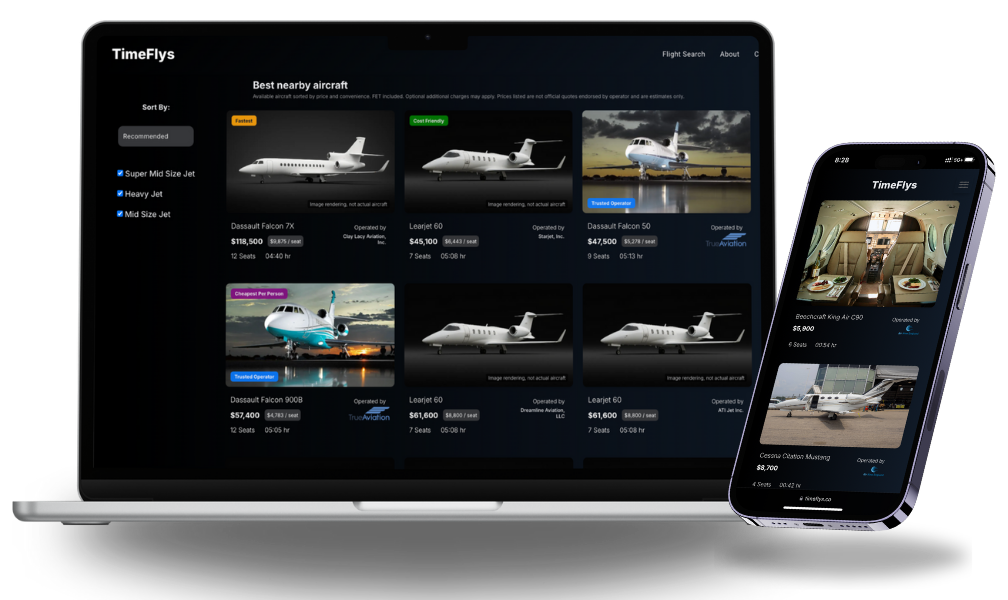
Phoenix sits at the center of one of the busiest private aviation markets in the Southwest, served by multiple airports including Sky Harbor (PHX), Deer Valley (DVT), Scottsdale (SDL), and Williams Gateway (IWA). TimeFlys lets you search aircraft that may be available for your trip, compare estimated charter costs across operator listings, and review aircraft and operator details before you submit a charter request. Pricing and availability are confirmed directly by the operator, not by TimeFlys. Whether you're flying for business, a weekend trip, or a major local event, this page explains what to expect from the booking process and how to make a well-informed decision. Final pricing and availability are confirmed by the operator.
The AIR CLUB Advantage
Earn Air Club points on every booking. A point with us is different than a point anywhere else. Backed by our Air Club Concierge, they become your secret weapon for upgrades, premium catering, ground transport, or transforming an ordinary trip into something unforgettable with enhancements you didn’t see coming.
FAQs
Why Choose TimeFlys for Booking a Private Jet in Phoenix?
Most charter search experiences give you a phone number and a vague promise. TimeFlys is built differently: it's a search and comparison platform that surfaces aircraft that may be available for your route, shows estimated pricing by aircraft category, and displays operator details so you can evaluate who you're flying with before you commit to anything. There's no broker markup layered into what you see.
Phoenix travelers benefit from this approach because the local market has real options across aircraft categories, from very light jets suited for short hops to San Diego or Las Vegas, to heavy jets for transcontinental routes to Miami or Boston. Seeing estimated costs side by side across those categories helps you make a practical decision rather than guessing at what a given operator might charge.
TimeFlys doesn't operate aircraft or employ pilots. When you submit a charter request, that request goes to FAA-certified charter operators who confirm pricing and availability directly. Final operator-confirmed pricing may differ from the initial estimate based on aircraft positioning, fuel costs, and timing, and that's something we state plainly rather than obscure.
How TimeFlys Solves the Lack of Transparency in Charter Booking
Charter pricing has historically been opaque. A traveler calls a broker, gets a number with no context, and has no way to know whether that figure reflects actual operator cost or a margin stacked on top. TimeFlys addresses this by showing estimated charter costs alongside the aircraft type, operator name, and relevant operator details, so the information is visible before you ever make contact.
Transparency also means being honest about what changes. Estimated prices on TimeFlys reflect conditions at the time of search. If an aircraft repositions, if demand spikes around a major Phoenix event like the Waste Management Phoenix Open or spring training, or if fuel costs shift, the operator-confirmed price may differ. We'd rather tell you that upfront than let you discover it later.
Operator credentials matter too. TimeFlys surfaces details about the charter operators whose aircraft appear in search results, including their operating certificates and safety program affiliations where available. Certifications like ARGUS Platinum or Wyvern Wingman are issued to operators, not platforms, so reviewing that information at the operator level is where it actually counts.
What You Need to Know About an Operator Before Booking a Phoenix Charter
Every private charter flight in the U.S. must be operated under FAR Part 135, the FAA's on-demand air carrier regulation. That certificate belongs to the operator, not to a marketplace or broker. Before you confirm any charter, it's worth verifying that the operator holds a current Part 135 certificate and that the specific aircraft you're flying is listed on it. TimeFlys surfaces operator information to help you ask the right questions.
Safety audit programs like ARGUS and Wyvern evaluate operators on maintenance practices, pilot qualifications, and operational procedures. These ratings are voluntary, and not every legitimate operator pursues them, but they provide a third-party data point worth considering. When an operator's listing includes audit status, that's meaningful context rather than marketing language.
For Phoenix-area departures, the airport you use can affect which operators are positioned nearby and how quickly a flight can be arranged. Deer Valley (DVT) and Scottsdale (SDL) are popular among private operators for their lower traffic and efficient FBO access. Williams Gateway (IWA) handles larger aircraft well given its runway capacity. Knowing which airport suits your aircraft category and schedule is a practical part of the booking conversation.
A Local's Guide to Flying Private to and from Phoenix
Phoenix has several airports that handle private charter traffic, each with different advantages. Sky Harbor (PHX) works for travelers who need proximity to downtown or connecting international itineraries, though commercial traffic adds complexity. Scottsdale (SDL) and Deer Valley (DVT) are generally preferred for private departures given their dedicated FBO facilities and faster ground handling. Chandler (CHD) and Falcon Field (FFZ) serve the East Valley. Your choice of departure airport should factor in where you're staying, your aircraft category, and your departure window.
Popular routes from Phoenix include flights to Dallas, Las Vegas, San Diego, Los Angeles, and Denver, most of which fall within the range of light to midsize jets. Longer routes to Miami, Houston, or the Northeast typically call for super midsize or heavy aircraft. Estimated costs vary considerably across these categories, and positioning fees can apply if the aircraft needs to reposition to Phoenix before your departure.
Timing matters more in Phoenix than many travelers expect. Demand around major events, including the Super Bowl when hosted locally, PGA Tour stops, and spring training, can tighten aircraft availability and affect estimated pricing. Booking earlier during those windows gives operators more lead time to confirm aircraft and finalize logistics. If your schedule is flexible, flying midweek or outside peak event dates often opens up more options across aircraft types.
Explore More Locations
Explore more: AZ Private Jets| Prescott| Prescott Valley| Queen Creek| Fort Wayne to Phoenix Flight Time and Cost| Dallas to Phoenix Flight Time and Cost| Phoenix to Los Angeles Flight Time and Cost| Phoenix to Cincinnati Flight Time and Cost| Phoenix to Monrovia Flight Time and Cost| Phoenix to New York Flight Time and Cost| Seattle to Phoenix Flight Time and Cost| San Francisco to Phoenix Flight Time and Cost| Detroit to Phoenix Flight Time and Cost| Lawton to Phoenix Flight Time and Cost| Phoenix to Kansas City Flight Time and Cost| Phoenix to Green Bay Flight Time and Cost| Phoenix to Honolulu Flight Time and Cost| Phoenix to Gainesville Flight Time and Cost| Phoenix to San Francisco Flight Time and Cost| Phoenix to Miami Flight Time and Cost| Home
